Sunday, July 13, 2014

The Hill Towns of Monte Stella


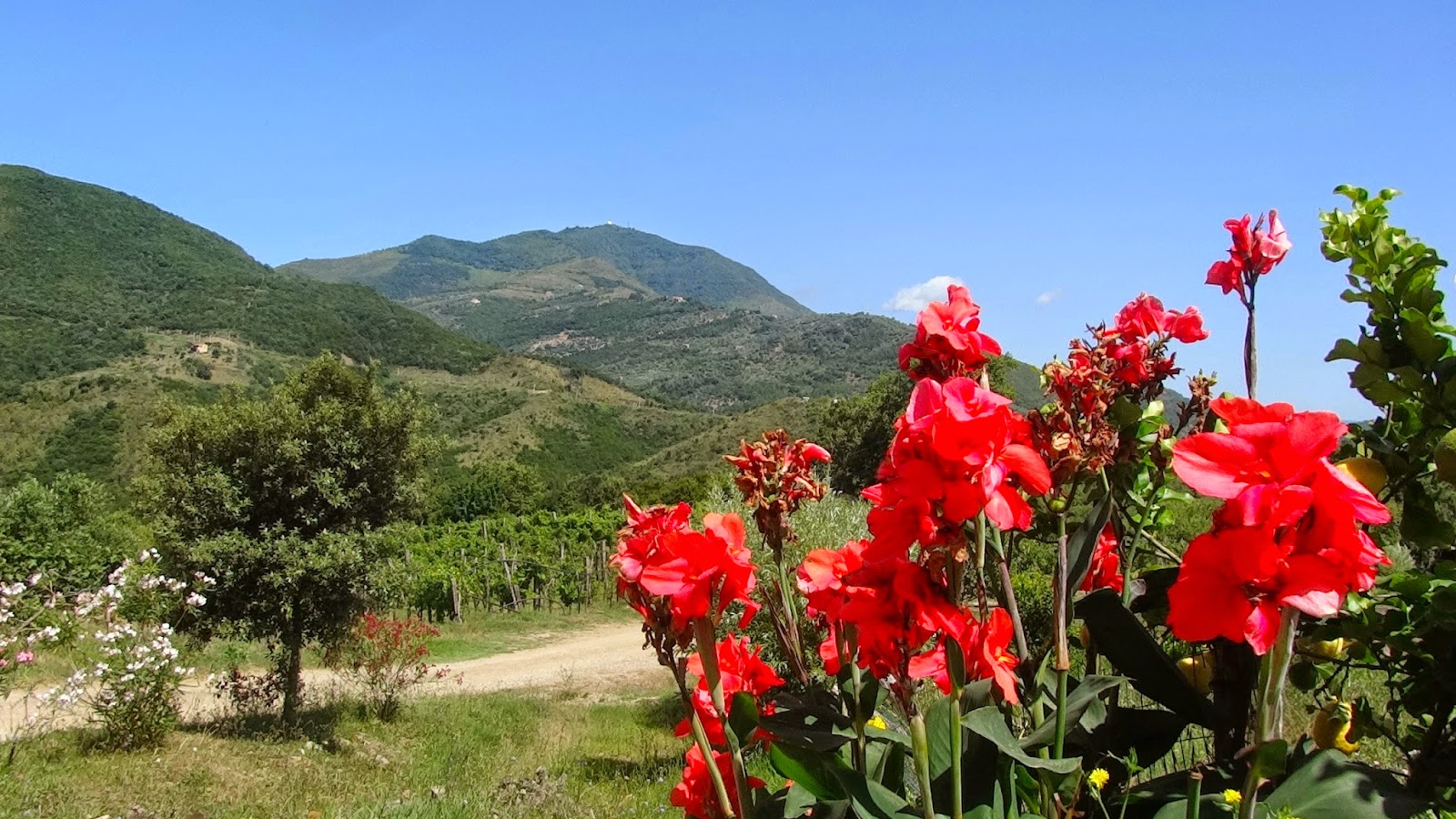
 OK, chug that last demitasse of espresso, grab your sunglasses and out the door you go.  Today we’re touring the beautiful mountain towns of the western slopes of Monte Stella.  Hop in the front seat of Francesca, our cute little Fiat Panda hatchback, buckle up and roll down the window; the air conditioner isn’t worth a darn and besides, you’ll soon be enjoying those mountain breezes, replete with the scents of wild rosemary, thyme, myrtle, broom, and catmint.

Off we go through the little frazione of Madonna del Carmine and around the rump of Monte Tresino, down the valley toward the sea.  But this time we’ll take the back road up Colle San Angelo toward Castellabbate and take the switchback across the valley and onto a spur of Monte Stella where Perdifumo shines in the distance.  Monte Stella.  Star Mountain.  To my prosaic mind, so named because it has spurs jutting out in all directions, like a ten-pointed star, and some of those spurs have two and three spurs of their own, such that this grand mountain dominates the whole coastal area between Agropoli and Palinuro on the coast and Vallo della Lucania inland.  Of course to my friend Fabio the significance of the mountain is much more poetic, reaching back to the Etruscans who had trading posts in this Italic hinterland as far back as the eighth century BCE.  The Etruscans, those adepts at all things prophetic and sacerdotal, used the huge mountain, named after their god Cilens (hence Cilento, the original name of the mountain), says Fabio, as an axis mundi, an axis of the universe, siting northward to the Sorrentine Coast and southward to Sicily in order to create their templum, or supernatural grid, over the whole area, and thereby keep the cosmic forces in balance.  My pious friend Fernando, on the other hand, sees Monte Stella very much under the aegis of Madonna della Stella, Saint Mary of the Star, showing me how Renaissance pedants saw in the majestic profile of the mountain the mantle of Mary, shrouding the little towns on her slope like a broody hen harboring her chicks, and even showing me several Renaissance paintings of her with the familiar mountain profile in the background.

I think you’ll find it easy to accept both explanations as you scan the apex of this majestic beauty, some 1131 meters up from the sea.  Hard not to feel the spiritual power when you approach the rustic shrine of the Madonna at the apex and scan those far distant horizons.  But that’s for another day.

First we come to the gorgeous little village of Perdifumo, huddled on a ridge overlooking the Tyrhennian Sea.  Greek settlement in the area begins in the 4th century BCE, and Roman settlement is attested by a beautiful Bacchic sarcophagus now in the museum, a reminder that Bacchus was a god of resurrection and eternal bliss some centuries before Christ subsumed that role in Italy.  The main part of the town was first settled in the 11th century, when it is attested under the protection of the monastery of San Arcangelo, as so often with these Medieval towns.  The town derives its name from the fact that it lies at the lower end of a torrente,  one of those mountain streams so important for milling and water supply. Hence pes de flumine, Perdifumo.  My first trip to the town I drank from a beautiful fountain fed by the river, only to look up and see a sign that read “Aqua non potabile!”  A local nonno, seeing my look of consternation, laughed and assured me, “If you drink that water you’ll live a hundred years!”  So far, so good.  Like many another Cilentan town, Perdifumo has seen a variety of overlords, from the Normans of the 11th century, to Ladislav of Durazzo in the 12th, to the Aragonese in the 14th, and finally became the feudal possession of the powerful Sanseverino family.  Today it is a pretty little Medieval gem which cascades down the ridge of one of Monte Stella’s spurs, from the 16th-century Church of San Sisto, whose pretty five-story belltower dominates the town, to the lower reaches.

A few kilometers eastward along a narrow, twisting mountain road brings us to the aptly named Mercato Cilento, ‘Cilento Market’, not much more than a crossroads.  But a crossroads of no fewer than five local roads and therefore a logical emporium for all the little towns encircling the middle slopes of the mountain.  Mercato, frankly, is rather nondescript, but I can never see it without a smile as I remember that my dear friend Fernando, when he was in college at the University of Salerno, used to take the train back home to his home on the mountain on weekends, collect produce from local farmers, and bring it to Mercato in a trusty little Api, those adorable little “Bee” trucks which look like an old Cushman golf cart attached to a small truck bed.  Fernando would deliver most of his produce to local markets, sell the rest in the street market at Mercato, then take the train back to school on Sunday night.  One of the many ways we are brothers born of different mothers, since I worked my way through college as well, although in my case as a jeweler.

From Mercato we take another provincial highway southward along the western flank of the mountain, around numerous switchbacks which make Sandy feel right at home, and arrive in the quaint little town of Serramezzana.  We park in a lower Piazza, then wander up toward the mother church along the main street, in this case little more than a lane, past the majestic eighteenth-century Palazzo Materazzi where we are greeted by a deputation of the town’s canine element, one of whom, a cute little bandy-legged mutt with an adorable underbite, offers to accompany us to the church.  There a little nonno on a mission to the hardware store stops and engages us in a conversation which is, sadly, in such thick dialect that we understand perhaps a fourth of it.  But it’s the human interaction that matters anyway, and we think we hear that he is 87 years old, was born in Caserta north of Napoli but married a local girl and has lived here ever since.  He’s had four children, two of whom are now dead, along with his wife.  He has two grandchildren, one a young woman who is a college graduate, another, a male, who is in business in Napoli.  He never smoked or drank (hard liquor, we assume; wine is not considered drink but food in these parts), but still had lymphatic cancer five years ago, from which, thank God and Santa Maria, he recovered.  He doesn’t know our friend Marco Marrone but knows the family, though he corrects us by insisting the correct dialect pronunciation is ‘Marunc’.

We reluctantly say goodbye to our new friend and make our way back down to the car where a different canine delegation greets us, and then we’re on the road again, this time through the little village of San Mauro Cilento and on to Galdo. Galdo is famous (at least in our minds) as the birthplace of one Fernando La Greca.  Another town cascading down a ridge spur, but this time we park at the top, above the beautiful little church of San Rocco, with its amphorae in the two pedimental niches where the bells used to be.  Now it sports a handsome, separate campanile.  Galdo’s name derives from the German wald, ‘forest’ and is a reminder that the village was also under Norman control at one time.  We stroll down the steep corso toward the residence of the Galdi barons, noting the eerie silence of the place (Galdo now has less than 100 inhabitants) and the fact that many of the buildings have been stripped of their stucco, a concession to practical necessity, we suppose, but also a way to show off the beautiful local stone from which these old walls of the Cilento are constructed.  Not to speak of giving the town a pleasing homogeneity, with the sepia tones of the stone walls and the grayish-oranges of the roof tiles, now often fuzzy with lichens and moss.

Back up the steep corso we struggle, slipping on the flags of the street worn smooth by thousands of feet, most now long since dead, and we’re off to nearby Celso, in some ways a twin of Galdo.  We wind our way up the narrow corso, past the little park clinging to the cliff where we’re happy to see lots of bambini playing, a sign that Celso still has a chance to survive, and up to the imposing Church of the Assumption, from whose piazza we enjoy a spectacular view out over the Sea.  We wind our way up through the main piazza, again, lively with people, and note yet another huge palazzo of the family Mazzioti, baronial lords of several of these towns.  All around, defensive walls, turrets, strong gates on even rather modest buildings, remind us of the tragic history of the area and how beautiful, ironically, that history now makes these towns.

Back in Francesca we head eastward along our winding provincial road to the town of Pollica.  Situated on yet another spur, some 370 meters above the sea, of which it has yet another spectacular vista, Pollica probably owes its name to Greek Basilian monks who settled a monastery here in the ninth century, escaping the iconoclastic inquisitions of the Byzantine empire during this time; pollicne is ‘small town’ in Basilian Greek.  In 1183 it was granted to the Sanseverino family by the Angevin Robert Guiscard.  The town (and its inhabitants, n.b.) was sold as feudatory to several baronial families over the centuries, ending with the Capano barons, who built in 1610 the massive square tower that dominates the upper town.  Lower down we see the huge Palazzo Cortiglia, reminding us that there were Spanish overlords here as well, and make our way to the lovely seventeenth-century Church of San Nicholas, lovingly restored in the last century, whose bright yellow walls and campanile can be seen from the road miles away. 

From Pollica we wind our way down a series of tornanti (switchbacks) to the coastal town of Acciaroli where, you will remember, Papa Hemingway may or may not have written the first draft of Old Man and the Sea but whose cerulean waters he definitely fished and where he definitely consumed massive quantities of Cilentan wine.  Off we go down the coast road to Agropoli where we’ll encounter other beautiful coastal villages. But I note that your eyes are glazed and your lids heavy, so I will bid you a buon riposo and wake you when we’re back at the villa and I’ll have ready for you your own glass of Cilentan wine, in this case, nectar of the gods, otherwise known as Chateau Rolando.

Saturday, July 12, 2014

What We Like about the South


The view from Castelabbate

The mountains of the Cilento
The council of elders in the Piazza of Agropoli

The Monti Alburni

Cicerale, one of the hundreds of beautiful hill towns of the South

A rustic campanile

Warm, friendly nonne in Stio

View from the Castello of Agropoli

The Chiesa di Santa Maria in Castelabbate

Roccadaspide, where the town encircles an archaeological site

The mother church of Stio
     We’ve been fortunate enough to see quite a lot of Italy.  Our first trip over, back in 1995, we lived in the little town of Malmantile, about 15 miles west of Florence, in a beautiful agriturismo made from a nineteenth-century villa and its farm buildings (our apartment was in the barn) and used it as a base for exploring Florence and the surrounding areas of Tuscany.  The last two weeks of our stay we rented a car and meandered about, over to the coast to Pisa and Lucca, up to Liguria to see the marble mines, down to Perugia where we stayed for several days and explored the towns of Umbria (Assisi, Gubbio, Orvieto among others) and then toodled down toward Rome, exploring along the way.  In subsequent  trips we’ve seen parts of Lombardia, the Veneto, especially Venice, the Aegean coast, that cute little independent country San Marino, quite a lot of Lazio, especially the mother city, Rome, and many of the towns of the Bay of Naples.  And everywhere we have found incredible beauty in this spectacular country.  Still, nothing quite prepared us for the rugged, untamed beauty of the deep south.  To my highly biased eye this is quite simply the most gorgeous part of Italy.

Part of that, ironically, has to do with the tragic history of the Mezzogiorno, the deep South.  We used to have a saying down home, “So far behind that you wound up ahead.”  Something like that has happened here.  A famous book was written about the backward aspect by a northern Italian named Carlo Levi.  Levi was a doctor, artist, and anti-Fascist who was ‘rusticated’ to the extreme south by Mussolini’s thugs back in the thirties for failing to toe the political line and wrote about the experience in a book called Christ Stopped at Eboli.  Eboli is a little town about 30 miles from here, right at the edge of the Cilento.  In the introduction he explains the title thus:  “But in this dark land, without sin and redemption, where evil is not moral but is a terrestrial pain that is forever in things, Christ did not descend.  Christ stopped at Eboli.”  My friend Robert Pelecchia comments, “Levi spent his exile in Aliano in Basilicata, but the heartbreaking passage expresses an idea that can be extended to all the lands of the South that have, until recent times, been cut off not only from Europe but even from Italy.  The lands of Lucania, Calabria, Sicily and Puglia, united by centuries of poverty, backwardness, and hardships of every kind.  Lands where everything arrived late and when it did arrive hardly anyone noticed.  Lands that have lived under the yoke of alternating masters, afflicted by wars and famine, sold along with their inhabitants according to the feudal customs that remained in force until 1806.  Too far away to catch the flashes of the Renaissance, the Enlightenment and Romanticism.  Too uncomfortable for the first travelers who crossed Italy in the eighteenth century.  Too poor to erect wealthy cities and monuments.  Finally, stripped of any remaining authority by the unification of Italy, which gave the final blow to the slightest form of development under the Bourbon reign which, however questionable, fostered and favored the first businesses in the South.

“The South is the son of a troubled history, giving the twentieth century mass migration, leaving the most helpless and fragile part of the population behind, blocked by agriculture and a legacy that is centuries old, arriving up to modern times almost unchanged.”

And it is that last element which explains the terrible beauty of this land, a place where, in the words of the German writer Peter Amann, "Italy today is still Italy—an ideal destination for many tourists, both Italian and foreign, who are looking for the most authentic roots of a country that elsewhere is now far too globalized and transformed.”  Though even here the modern world is fast intruding, it is still possible to wander through whole towns which are essentially Medieval, with their tortuous streets, buildings clinging to the cliffs and leaning against each other for support, the beautiful little mother churches with Gothic interiors, often with traces of Medieval frescoes lovingly conserved and their rugged campanili soaring up above the town and pealing out the hours.  Here we can drive the little mountain roads and see nothing for miles but mountains and sea and the Italian scrub called macchia and the occasional farmhouse and village—no shopping malls, no neon signs and billboards, nothing but untrammeled beauty.

More’s the pity, then, that the Mezzogiorno, and especially the Cilento, this little western corner of Lucania, is still terra incognito, not just to Americans but to the majority of Europeans and even Italians themselves!  Our first trip over we were advised by a wonderful travel agent who was a retired shoe wholesaler and had spent many years traveling in northern Italy and so could offer us a way to live for a summer in Italy for about the same price it would have cost us for two weeks at Myrtle Beach.  We will be forever grateful to him for that.  But when I mentioned the possibility of seeing a bit of the south, especially Pompeii, he literally shuddered.  “No, no, no!  Don’t even think about going south of Rome!  You’ll be lucky to escape with your lives, much less your money and jewelry!”

So you can imagine that we were filled with a certain trepidation our first summer here.  Trepidation which lasted about a week.  This area reminds me of nothing so much as my little hometown of Martin, Tennessee back in the fifties—a bit provincial, yes, but full of warm, kind people and a safe, nurturing place for little knuckleheads like me.  Here in Agropoli people still sleep with their doors unlocked and the windows open, walk the streets all hours of the night in perfect security.  Yes, they can be reserved and even hostile to outsiders, but who can blame them when they have been beaten down and denigrated by those outsiders for so many centuries?

Even more tragic, perhaps, is the fact that many northern Italians harbor the same sorts of ignorant prejudices about the Italian South as many of the ‘Yankees’ did about my South when I was growing up:  Southerners are lazy, dimwitted, criminal.  I’ll never forget at a band contest in Virginia Beach encountering kids from Minnesota who were amazed that we Tennesseans wore shoes!  So it has been heartening to return to the beautiful little hill town of Castellabate and see how ‘touristy’ it has become in the last six years.  At the instigation, would you believe, of a very popular Italian comic film called “Benvenuto al Sud” (“Welcome to the South’).  The film centers on a Milanese postal worker who is scamming the system in hopes of a transfer to Milano by faking a disability and is finally caught out.  His punishment is to be banished to a tiny post office in a fictional town in the deep South.  He rages, he begs, he weeps, he threatens suicide, all to no avail.  And of course his callow, superficial wife simply refuses to go.  Finally he faces the inevitable and makes the move, fully expecting to be murdered in no time, and discovers...exacttly what we have:  a gorgeous little Medieval village filled with quiet, reserved, but wonderfully warm and generous people, and traditions of family, food, and faith that have survived unscathed for millennia.

Well, to make a long story short, this tender-hearted film was a revelation to most Italians, and when they discovered that the fictional town was, in fact, our pretty little gem, Castellabbate, the pilgrimages began.  And everywhere in the little town we see the signs of new prosperity:  tasteful but brightly painted signs, restoration, new pavers on the old streets, a pretty new terazza and parking lot on the eastern fringe of the town, lots of new shops and restaurants catering to the tourist crowd.  All done, I am thrilled to say, in a way to maintain the charm of this little newly discovered treasure.  

I can only hope that the discovery of Castellabbate will be an entrĂ©e to the discovery of the whole area.  The Cilento doesn’t have much going for it from a 21st-century perspective.  The terrain is so harsh that industrial farming is laughable, the roads keep sliding off mountains so transport is crude at best, there is really no large-scale industry, much less biotechnology.
   
      But!  But!   But!   There are those traditions.  And that incredible beauty.  And those are assets that are more valuable by the day, as so much of Italy begins to succumb to the stultifying effects of globalization and commercialism and Italians begin to yearn for the disappearing essence of their fair country.

Friday, June 27, 2014

Saint Mary of the Olives


    Tuesday morning Fernando rounded us up to take us north to the archaeological museum in Salerno, his second city.  Salerno is a city of a bit over 100,000, a port town with a lungomare (coastal stretch) but most of which is sort of glommed onto the precipitous cliffs inland.  Pretty, but difficult to maneuver in.  We had come up the coast road, logically, but Sandy made an offhand remark about a picture of the sea, and, Fernando being the enthusiastic photographer he is, that’s all it took to send us off on a search for a spectacular vantage point.  Now, we were under the impression that the museum, like most such facilities in this part of Italy, was keeping morning and late afternoon hours only, and as the minutes ticked by and traffic became more and more intractable, I began to see my chance of seeing this gem of a museum slipping away.  Fortunately Sandy was kind enough to relent, and we took the next exit off the ‘beltline’ and headed downhill into the central city.  Along with everybody else in Salerno.  Salerno is filled with modern buildings, all on Medieval streets.  We inched our way through stop-and-roll, doglegging right and left, to the bottom of the cliff where we finally accessed the parking lot along the lungomare.  We strolled up to the corso, the main drag, now lined with modern office buildings on the ground floor of which were shops for some of the most famous names in fashion. Sandy perked up alarmingly, and I suspect her clone across the ocean in Brooklyn had tingling ears as well.

The museum building itself is a treasure.  Incorporated into its fabric, so to speak, is the western third of the cloisters of a medieval Franciscan monastery.  The middle third is now occupied by an ugly street, so typical of the disregard for the past in this country in an earlier era.  The eastern third and the bulk of the monastery is now a military camp.  What would gentle San Francesco think of that?  The museum is a hodgepodge of materials from all over southern Campania, mostly things excavated (haphazardly) during the Fascist era.  Once again, part of Mussolini’s mania for recovering the glorious Italian past—in the service of one of Italy’s most inglorious political hacks.  True to form, there were glorious things there:  neolithic artifacts from Sala Consilina, Pontecagnano, Eboli; gorgeous bronze and ceramic Etruscan goods from Fratte, a suburb of Salerno, Greek colonial ceramics so gorgeous our eyes were bugging, a good sampling of Roman sculpture, realia.  All incredibly poorly provenienced and documented.  The watchword for many of these excavations was, “Get this shit out of the ground and on display, and archaeological standards be damned!”  Not that I blame those poor guys; Mussolini was not noted for his gentle tolerance for those who did not cooperate with his megalomaniacal ambitions.

Happily, the museum remained open past 12:30, so we had ample time to savor it all.  Outside in the courtyard, a group of what appeared to be third graders was busy with some sort of art project and Sandy was happy to see that ‘cut and paste’ and the enthusiasm it engenders are universal.  My favorite of the courtyard artifacts was a Roman dolium, one of the huge terracotta fermentation vats for wine that the Romans used, almost 5’ tall, easily 4’ in diameter and holding some 200 gallons.  The Romans embedded these up to their shoulders in sand in the floors of their wine cellars.  Not so easily dinged and broken (one of these would easily have cost the equivalent of several hundred dollars) but, more importantly, offering thermal stability.  Cool fermentation and aging is the key to good wine.  The Romans new this perfectly well, but artificial refrigeration was beyond their technological capability so they found the best form of natural refrigeration they could.

After a rather disappointing lunch at a local restaurant—why would you drown fresh seafood in a heavy brown gravy?—we headed southeast down the A-3 autostrada toward the Monti Alburni, one of those dramatic-looking ranges we see in the Cilento that just seems to rocket out of the plain and whose limestone escarpments on top make them seem twice as tall as they are. We exited the autostrada, wound our way across the valley of the Calore River and into the foothills of the range to the beautiful little Medieval village of Serre, where Fernando had arranged to meet Antonino Mennella.  Signore Mennella is the proprietor of a local olive orchard and frantoio (oil processing plant).

We meandered out of town to the east, toward those gorgeous mountains, and, wow, what a place!  The Azienda Agricola Madonna dell'Ulivo is directly across the road from the lovely medieval church from which it takes its name.  Saint Mary of the Olives.  We have seen Mary associated with lots of things in our travels, from the sublime to the banal (one of the Greek isles venerates Santa Maria of the Public Baths), but this was a first.  And how appropriate!  Mary has simply subsumed the role of Athena/Minerva, ancient goddess of the olive tree.  Again, some of my Christian friends find those reflections of paganism in Christianity uncomfortable at best, but I think it was (and is) the genius of the Church that it tried to minister to the peasants where they lived, not on some exalted level.  And, make no mistake, the olive tree has been nothing short of life itself for Mediterranean peasants for thousands of years.

First of all, the olive tree will grow in marginal land where practically nothing else, not even the hardy vine, will grow.  It requires a minimum of care and in exchange for that care gives back the precious olive, year after year after year.  There are olive trees alive in the Mediterranean today that witnessed Roman soldiers marching by.  Or at least the shoots of those trees; olives are like redwoods in that the upper stories may be destroyed by cold or fire, but it is practically impossible to destroy the roots.  It is common to see a rugged old stump 8’ in diameter and all around its perimeter young shoots have developed into new, productive trees in turn.  In some cases where the stump is not too large these shoots will gradually merge to form a large, reticulated new trunk.  We see many of the old timers here in the south as well as the rejuvenated forms.  But not in the north!  Back in 1987 a severe freeze hit northern Italy and persisted at subzero nocturnal temperatures for 3 days.  And killed practically every olive tree north of Rome!  But the first summer we lived in Italy, 1995, we lived in Tuscany, and all across the landscape the young olive trees that had sprouted from those old roots were 15’ tall or so and were beginning to produce olives.  Old timers here used to say you planted an olive orchard for your grandchildren; it takes the tree almost 20 years to become fully productive, but then it will produce a bumper crop every other year for hundreds of years.

And not just any crop, but the precious olive.  Olive oil is packed with enough energy—a single tablespoon has something like 350 calories—to sustain an adult human for several months in a famine.  And not just any calories, but calories in one of the most healthful foods on earth.  A blessing indeed.
So we were predisposed to enthusiasm when we hit the ground at Signore Mennella’s azienda, but were still bowled over.  Beautiful ranks of olive trees cascaded down the hillside in perfect order, those lovely grey-green leaves shining in the sun, and off in the distance those dramatic cliffs.  Turning westward, there was the azure of the sparkling Tyrrhenian Sea.  And everywhere those delicious scents of wild rosemary, oregano, nepitella, spearmint.  Interspersed between the olives were fruits trees and we took the occasion to enjoy our first apricots plucked straight from the tree.

The frantoio was in an old farmhouse, but was anything but primitive.  Outside Signore Mennella showed us a brilliant stainless-steel apparatus for cleaning and destemming the olives.  Made in Germany, ironically, where they grow not one single olive. Inside, a large, brightly lit room with tile floors contained the other equipment for producing oil.  But not just any oil.  Signore Mennella produces a special kind of oil called nocciolo, very expensive but exquisite.  A word of explanation:  The olive is a berry that consists of a pit, a pulpy mass around the pit, and a tough, waxy skin.  The pulp, in turn, contains solids, the precious oil, and an aqueous liquid that it so bitter and astringent that if you were so foolish as to attempt to eat an unprocessed olive, even one dead ripe, your mouth would pucker up so tight you’d find it hard to speak for a few minutes.  Any southern kid who’s been stupid enough to try to eat an unripe persimmon (yeah, you know who) will know the feeling.  So the key is to separate the oil from the watery stuff.

No problem, right?  Oil and water have very different densities, as any cook who’s mixed a vinaigrette too early only to have it separate will know.  The problem is that as soon as those two components hit the air the bitter water (amurca is the Latin name) will start a fermentation which can be tasted in the oil.  So Signore Mennella has a special filtering device that separates the two as soon as they are macerated, rather than waiting for the physical action to do the trick for him.  More expensive, but a superior product.  Another surprise:  in the chapter of my book on olive processing I had commented it was odd that the Roman mill for pulping olives had a mechanism for ‘tentering’, that is, separating the millstones ever so slightly so that the pits would not be crushed.  Modern olive processors like to crush the pits because they make a very effective filter bed when pressing the pulp.  And then I made some excuse for why the Romans had screwed up.  Guess who screwed up?  The same dope who ate the persimmon.  Signore Mennella’s oil is called nocciolo because it is made from oliva denocciolato, pulp from which the pits have been separated, in this case by a centrifuge.  And why?  Because the pits also contain tannins which will taint the oil, ever so slightly.  

But appreciably.  We thanked Signore Mennella, made our way across the road to pay our renewed respects to St. Mary of the Olives, trundled home, and when we exited the car dear Fernando presented us with a bottle of the magic elixir.  It is hard to explain how much fruitier is this oil than the typical, even excellent, commercial oil.  So I’ll let you judge for yourself!  Fernando had actually explained to me about this special oil back in 2009 and I was so excited, despite my mistake, that when I returned to the states I googled it and bought some from an on-line specialty food purveyor.  Now, I ordered in November and after six weeks or so and no oil I wrote a snarky email asking where my oil was.  To which a nice young lady replied that this oil was produced in very small quantities and so was available only once per year while supplies lasted.  As the on-line ad had clearly explained.  I wrote a contrite email of apology and waited for my oil to arrive.  And when it did, in February, I was glad I had waited.  Signore Mennella’s oil is about double the price of a typical high-grade oil here, and he explained he had trouble selling in Italy, sadly, except to four-star restaurants, and so makes most of his sales through purveyors in Canada, the U.S. and Japan.  So imagine my delight when he showed us several bottles and I recognized the same logo I had seen on the bottle I had ordered!  It is available through Ritrovo.com out of Seattle and I encourage you to try it; these artisinal producers need all the encouragement they can get.  And in any case, the next time you enjoy a delicious, healthful olive oil, say a special little prayer to one extra-virginal lady who is the patron saint of, among many other things, one extra-virginal oil.

Saturday, June 21, 2014

Chopped, Italian Style


Our first night here, Fabio announced that he had offered my services as a judge in a local cooking competition and all he needed was my assent to confirm my reservation for Wednesday night at 8:30 at a well regarded local restaurant.  Sandy was naturally invited as well and would have free rein for her photography, as was Fernando.  I find the idea of an American telling an Italian of any stripe, much less an Italian chef, how to cook, pretty ludicrous, as I suspect you do, but who could pass off an offer like that?  So at 8pm on Wednesday night Fabio drove us from the villa to the Centro of Agropoli for the big event.  We arrived under threatening skies, and Sandy wondered whether she should bring an umbrella to which I responded in my typical flippant way that it wouldn’t rain.  Big mistake to flout the weather gods that way.
But first we ducked into the beautiful new Agropoli Commune, or city hall, where Fabio has his office and out from an office ran Katiruscea!  Hugs and kisses and laughter and much banter from our beautiful, funny, affectionate friend who, sadly, was on duty (Katiuscea is also a muncipal police officer) and so couldn’t come with us.  We strolled up to the main piazza and scooted down a side street to Ristorante da Ciccio, an elegant looking place where I was delighted to see my friend Dottore Luigi Crispini, a local academic who wrote a wonderful book on the Mediterranean diet, first studied here, and popularized in the West by American physiologist Ancel Keys, who lived here for many years.  I've happily bumped into Luigi several times over the years in our role as foodies.  Unlike me, Luigi definitely had the chops to judge this competition.  We schmoozed for a while (de rigeur in any such Italian gathering), met the lovely organizer of the event, Signora Anna Noviello, who directs a local consortium called Informagiovane di Agropoli, as well as the emcees, Gianni Petrizzo and his wife Raffaella Giaccio.  These two operate a local cable channel and were as good looking and charming as you might expect from two such Italian media figures. 
Eventually we got down to the business at hand, and the judges were seated at a large central table and other invited guests seated around the periphery.  Signora Noviella began a brief video to introduce the event....and the heavens opened.  I mean, it poured the rain, buckets, sheets, tons!  I’ve never seen rain like that in Italy and rarely in North Carolina except during a hurricane.  Forgive the crude expression, but this one went way past frog-strangler status to an actual turd-floater!  And all the while, Signora Noviella and our dauntless emcees soldiered on!
Next came a comedy skit by two talented local wits.  It was difficult to hear their routine, the rain on the roof was so thunderous.  Unfortunately we were in the part of the restaurant which was really a sort of pavillion.  You see them in many Italian restaurants, basically large tents to extend the seating and take advantage of the lovely weather in summer.  But not tonight.  First I felt one drip on my head, then another, and before long there were large puddles in several places on the floor and guests were frantically backpeddling to find higher ground.  And still our emcees battled on!  The comedic banter was so rapid that I could not have followed the Italian had I been able to hear it, but the comic timing was spot on and the locals seemed to enjoy it immensely.  And then we got down to the serious business of judging some food!
Actually I was relieved to hear that these were not professional chefs at all, but young Agropolitans who were beginning their training as Chefs a Domicilio, personal chefs.  You know, the kind that rich yuppies hire to come in and cook for them.  One of the goals of Informagiovane di Agropoli is to promote employment among young people in this area where unemployment among kids 19-25 is a staggering 47%.  Noble work indeed.  These youngsters (they seemed to range from about 17 to 24 or so) had spent several months under the tutelage of local chef Antonio Cedrola, learning basic cookery and developing recipes, before they went off to more advanced training.  Presumably they will eventually find work here catering to groups of tourists who rent apartments by the week in this popular resort area.
We ‘experts’ were introduced—local doctors, businessmen and women, Luigi, Sr. Alfonso Rotolo, who operates a local vineyard which produces wonderful wines which I have had the pleasure of sampling, and immediately to my right a beautiful young woman named Federica Voza.  Federica was probably the most qualified of all of us.  She was born in Paestum and grew up in the tourism industry; her family owns an agriturismo, a sort of Italian bed-and-breakfast on a working farm.  The Vozas also own a family farm where they grow grapes for another excellent winery, Polito.  And like the young competitors here, Federica found opportunity stifled by the Italian system but in her case fled to London as do so many bright, bilingual young Italians.  And like so many of them, she finally had had enough of the miserable continental weather (and I suspect of British stuffiness, though she was much too genteel to say so) and came back to mother Italy, settling in Rome where she promotes Italian luxury products, including foods and wines, to foreign importers.  Most important for Dave was that her English was impeccable and she was assigned translation duties for the idiot American.
Each student brought out and served one dish and then was briefly interviewed about the dish and the idea behind it.  These were obviously the dishes of talented novices, all quite good though lacking in a few technical areas.  Judges graded on presentation and taste.  Our antipasti were cute litlle skewered ciliego, cherry-sized mozzarella balls encircled by a wedge of sun-dried tomato and a basil leaf, a riff on the famous Caprese; another classic, melone con prosciutto, thin wedges of cantaloupe draped with the wonderful Italian cured ham; my personal favorite, squash flowers stuffed with the local goat-milk ricotta, but in this case a ricotta affumicata, smoked cheese.  The salty funk of of cheese perfectly balanced the sweetness of the flowers.
Primi, the traditional Italian pasta/starch dishes, were a vegetable puree covered with black Thai rice, very pretty but also very bland with a slightly bitter taste (which is not necessarily a bad thing in Italian cuisine); spaghetti draped with roasted slivers of eggplant, topped with chopped roasted tomatoes and served with a classic pesto on the side; and hand-made fusilli served with a zucchini puree.  Secondi were another local classic deconstructed, this time little fillets of uncured alici, the anchovies for which these waters are famous, stuffed with more local ricotta; and a Neapolitan specialty, pizza dough rolled around slices of sopresatta and mozzarella and baked, then slced into wedges.  The one dessert was a cute little bon bon composed of ricotta cheese, chopped local almonds and dried fichi bianci, the white figs for which the region is also rightly famous.  These last served with slices of local oranges.  We are in citrus heaven here.
With these delights we were served two famous local wines, a white Fiano, easily my favorite white grape in the world, an undiscovered treasure in most of the world which I am convinced has enormous export potential, and a red Piedirosso.  In an earlier blog I made some catty remark, I think, about Piedirosso being a ‘pedestrian’ grape.  Mea culpa!  Mea maxima culpa!  In my defense the only samples I had tried were decidedly, well..pedestrian.  But this guy was incredible:  huge nose, huge aromas of berries, coffee, pipe tobacco, huge tannic structure—God, how I miss tannins in modern wines—huge everything.  I noticed the bottle made its way around the table to Signore Rotolo, the winemaker, where it stayed.  I finally had to threaten him with a table knife to get it to come back my way.
Happily the judging was a simple 1-5 scale and none of the snarky comments of the television shows were required. Nor were they indicated.  All the food was good, and often better than good, the presentations were imaginative if not inspired—in short, these young folks have the potential to go places with cookery and I hope they do.  The winner, perhaps unsurprisingly, was the dessert, presented by Severio, who was as unaffected but attractive as his entry.  His victory prize was a chef’s hat with stripes of the tricolore.  Gotta score one of those babies before I leave.  The rain subsided, the crowd was congenial, the hosts delightful and the kids were irresistibly charming to a one.  As usual with Italian dining, the company was the most delicious dish of all.  The highlight of the evening for me was being allowed to present their diplomas to some of our young chefs.  But, oh, what a faux pas!  I didn’t realize the kissie-kissie thing was part of the protocols and so all they got from the Americano was a handshake and hearty congratulations.  I bet those Italian kids were just crushed.