Tuesday, September 6, 2016

Food Fests


 On Sunday we made our way down to Agropoli's Sports complex for the Agropoli International Street Food Festival, organized by 'Buongiorno Italia', a quasi-government agency that promotes all things Italian, especially food, throughout Italy and in various cities around Europe.

   The festival was originally scheduled for August 26-28 but was postponed to show solidarity with the victims of that terrible earthquake.  The event was organized in three sections, one for truck foods (it seems that truck food eateries are increasingly popular in Italy too), one for traditional Italian foods, and one for international foods.  There was also a section for beverages, featuring a number of craft brewers, another trend which is popular here, though hardly as much so as in the U.S.

    Fall is the time for such festivals in Italy, and they usually revolve around food.  The traditional form, an outgrowth of the Medieval fairs, is the sagra, a festival that celebrates some traditional food or craft that is associated with a town or region.  There are literally thousands of sagre in the Fall all over Italy.  A quick check on the internet for just our local festivals reveals a Sagra of the Wild Boar in Sasso Cilento, one for the Cornish hen in Prignano, one for antique pizza in Giungano along with two other local towns, another for artisan pasta in Omignano, and one for the local Zeppoli in Rutino.  Zeppoli are Italian donuts, but they take dozens of different shapes.  Our local ones tend to look more like funnel cakes and are made in much the same way and often even sprinkled with powdered sugar.  There are also feasts for figs, especially the white figs famous in the area, for buffalo products, no doubt especially mozzarella di bufala, one for onions, another for grilled meat, two for wine, others for eggplants, potatoes, plum tomatoes, bread, beef products, and pasta, including one in the little town of Felitto which we visited last year (and almost starved) for the particular form of fusilli that was allegedly invented there.  There's one at San Mango for sfriunzolo, a dialect word which refers to a dish with pork products and peppers which coincides with pig butchering.  Based on my hick upbringing I'd speculate that the pork products involved will be organ meats, the most perishable of pork products; down home the locals made a virtue of necessity and fed the hearts, kidneys, spleen, and such to their neighbors who helped with the slaughter and turned the event into a real feast.

    There are other sagre for bocconcini, the little 'mouthful' sized mozzes that we love so much on pizza, for fish, and for anchovies specifically.  Then there are the towns which just cut to the chase and celebrate whole categories of food, like Trentinara, which celebrates bread, and my favorite, Pattano, which celebrates FOOD!

    Italians have a wonderful talent for celebrating life, and you will notice that most of the sagre celebrate humble peasant food and not haute cuisine. Good, simple food and the solidarity of close friends and family have sustained the locals in this economically disadvantaged part of Italy for centuries.  With good food and friends, the party is ON!

     Truth be told, this festival was a bit disappointing.  I'm afraid many of the participants had other commitments, or else they knew that the tourist season in Agropoli was over precisely at midnight on August 31, and looked for greener pastures.  In any case, the food segment of the festival (there was also the inevitable carnival) had basically been collapsed into one zone, a large parking lot around the perimeter of which were food and beer stands of every sort and in the middle of which were numerous picnic tables for the diners.  There was a DJ up front playing mostly electronic music, too loud, as in most of Italy, but not obnoxiously so.
The fried seafood stand

Sandy's anchovies, shrimp, calamari and 'zeppoli'.


Stirring the pot

Paella


We scanned all the food vendors, then Sandy settled on an assortment of deep-fried seafood and a soda, and I went for a dish of paella and a beer.  Sandy's dish contained fried calamari, anchovies (the real ones, fried and eaten whole, not the little fillets you get in the tin), shrimp, and the Italian version of hushpuppies.  The stand consisted of a series of deep-fat fryers being manned by several burly Italian men, periodically dumping various sea critters out on a draining board and loading up with more.  Meanwhile a squirrelly little ragazzo ferried the hot food over to deep chafing dishes and doled it out into paper cones and aluminum trays.

      My paella was being cooked in a huge paella pan, easily 5' in diameter, and consisted of shrimp, mussels, calamari and what purported to be lobster but was in fact lumps of that artificial crab meat you find at the grocery.  The rice was a brilliant yellow, artificially colored, I'd wager; no way they could afford enough saffron to color at least 50 pounds of rice such a brilliant hue.  Little fresh peas set off the color nicely with their bright green flecks.  Not great, but not half bad.

     One stand was selling all sorts of fritture, 'deep-fried foods', which seems to be a theme in fairs the world over.  Another stand served pork ribs which we saw being barbecued on a huge wood-fired grill in the shape of a flattop.  Elsewhere juicy portions of pork were being cooked on a large circular grill suspended by chains over a red-hot tray of embers and swung around in looping circles by a grill man who periodically turned the meat and moved it from hot spots to a cooler spot.  Further along there was a strange little food truck with a long row of skewered meats attached to rotating spindles.  The meat looked like thick bacon cut into squares of about 1/2" and threaded onto bamboo skewers and slowly rotated before a tray of embers.  Beside this was a variation on curly fries, a clever little device which cut potatoes into a long spiral.  These were threaded onto large spits, about 2' long, and the whole inverted into deep fryers and cooked to a golden hue and quickly salted.  A sort of continuous potato chip, as it were.

Fritture, including seafood and veggies

Mixed grill, fair style

And here's the grillmaster

Italian kebabs

A new kind of curly fries

     Another stand had various Italian specialties, including a huge selection of arancini, 'oranges', not really oranges at all but balls of cooked rice wrapped around a variety of fillings such as cheese, meat sauce, or peas, then dipped in an egg wash and covered in bread crumbs and deep fried.  The same stand sold a selection of Italian dolci, sweets, the most beautiful of which were various brightly colored candied fruits.

Pizzette and arancini

Beautiful cannoli

Candied fruits

And lots of biscotti


    The piece de resistance was the stand which purported to serve American barbecue and 'hamburg' with cheese, cooked in the Italian way, whatever that means.  The barbecued pork smelled delicious, but was sliced thin like beef barbecue (harumph!) and served on huge buns topped with lettuce and with french fries on the side.  Customers were offered little packets of barbecue sauce, the kind you get at Arby's, and mustard.  Elsewhere a ragazzo was tending huge slabs of ground beef on two large charcoal grills and the sign claimed that these were 8 ounces each.  I suspect few Italians have a clue what a half pound is, since everything's metric here, but they appeared to be just that and were served on equally humongous buns.

"American skills, Italian style


    Apparently the thing which makes food 'American' to the Italian mind is the fact that it is served in such ridiculously large portions.  Sadly, based on my experience with American 'Italian' restaurants, there is a great deal of truth in that stereotype.

Monday, September 5, 2016

Caffè!

Our kitchen, with the trusty little Moka ready to deliver the good stuff.

Filo's espresso maker.  The concept of the Kuerig cup was actually invented by an Italian company called Lavazza.

The espresso machine at Bar Anna.


Outdoor seating on the piazza.

Another favorite bar, Bar Okay.  Cappuccino and a cornetto.

Cappuccino and pastry in Paestum.

Marocchino and gelato.

Twin baristas, beautiful and professional.

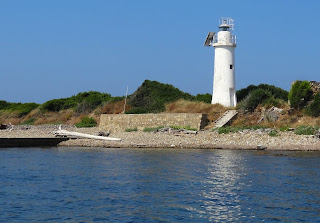
The crystalline waters off Isola Licosa.

Isola Licosa with its lighthouse,

Talk about service,  caffè delivered by watercraft.

       An Italian coffee shop is a beautiful thing, with its sleek bar, its sparkling chrome machines, the ranks and files of glasses and cups neatly arrayed before the mirror at the back of the bar, the lovely wooden glass-fronted cabinets with those ravishing pastries spotlighted, always freshly made at a local pasticceria that very morning, and the baristas with their cool, efficient demeanor.  In Italy, coffee is not so much a habit as a religion. And one, I have to say, that deserves all the veneration it receives.

      In his delightful little book, A History of the World in 6 Glasses, (from which I am cribbing shamelessly here) Tom Standage makes the case that the Enlightenment, that eighteenth-century intellectual ferment which saw the end of slavish adherence to the tenets of ancient Greek science and philosophy, was fueled by good old coffee.  Much as I venerate Greek thought, I suspect he’s right.  And it should be noted that no one would have been more chagrined by that slavish adherence than the Greeks themselves.  Modernists take Aristotle to task for relying on dualistic, Aristotelean logic, but they don’t take the trouble to discover that Aristotle himself knew perfectly well that his clever little intellectual tool had severe limits.  Heck, the guy thought it was hilarious to set up a perfectly constructed syllogism and prove that a goat was a type of bird!  In any case, think of all the ideas we owe to the caffeine-powered Enlightenment, not least our system of government here in the US.

     But that was a long time coming.

     My first book started with a very simple question, namely, how did Rome, a city of over a million souls, manage to feed its population in an era without refrigeration and sterile canning and with a very primitive system of transport.  I nattered on for another 250 pages and never really mentioned the most basic reason, namely that Rome provided the one most essential element of the human diet in glorious profusion.  That nutrient is safe drinking water, something we modern Americans take for granted, and shouldn’t.  The human body can endure for two or three weeks without solid food, and some of us, sadly, probably longer, but if we go without water for more than two days, we’re in serious trouble.  I was interested to learn that sailors stranded at sea in open boats who survived to give us an account of their travails report that it was not so much hunger that tormented them, at least not after the first few days.  It was ravenous thirst.  In fact, British sailors had an unwritten rule called “The Custom of the Sea” which was understood to mean that when a stranded crew was up against it and it became obvious that without sustenance they were all going to die, it was acceptable to draw lots and kill one of their companions so that the rest might have some chance of living.  Terrible, I know, but who is to say what we ourselves might do in similar circumstances?  But the thing which really astounded me was that they also drew lots for various portions of the corpse, and the two prized portions were the liver and the brain, for the simple reason that these two organs retain the most fluid after all the others begin to wither.  Imagine the bitter irony of floating in a sea of water and thirsting to death.  As Coleridge has the Ancient Mariner declare, “Water, water everywhere, and not a drop to drink!”  and ravenous thirst has driven some shipwrecked tars to madness, so that they began drinking sea water.  Sadly, salt is so hypertonic that it simply dehydrated them more, upon which they would repeat the cycle until they killed themselves in a raving fit.

All that by way of saying that throughout human history, various civilizations have devised ways of making impure water potable by creating staple beverages which purified it.  Thus the Egyptians and the civilizations of the Fertile Crescent were great beer drinkers, the Greeks and Romans great wine bibbers, and so forth.  Beer wort is, of course, boiled and therefore safe, and it has been experimentally proven that wine mixed with water in the proportions the Greeks and Romans prescribed kills all sorts of pathogenic microbes in brackish water, most especially typhoid and paratyphoid organisms.  The fact that alcohol in moderation has some delightful psychotropic effects as well hasn’t hurt their popularity either.  But when Islamic people, who by Koranic proscription are teetotalers, introduced distillation to the West and some bright spark figured out how to turn the process to distillation of wine and beer, the consequences were in may cases catastrophic.  Cheap gin was the bane of the poor in many cities, for example.  

     But our Muslim brothers more than compensated when they introduced coffee.  Before its introduction, most people in western Europe drank ‘small beer’, weak beer, for breakfast and lunch, since it was so much safer than municipal water supplies.  But coffee is boiled, and not only is safer, but leaves its drinker alert and energized instead of dazed and confused.  Coffee was introduced to Europe in the 1640s, and by 1674 an anonymous London poem heralded it as

…that Grave and Wholesome Liquor
That heals the Stomach, makes the Genius quicker
Relieves the Memory, revives the Sad
And cheers the Spirits without making Mad!

Actually, coffee had been known in the Islamic world for several centuries by this time.  The legend is that Arabic shepherds noticed goats eating coffee beans and becoming extremely frisky, ground up the berries and infused them in hot liquid, and were delighted by the buzz they got.  Coffee as we know it from roasted beans was evidently introduced from Yemen, and was known in Arabic as qahwah, pronounced as KAH-va, ergo our words kava and coffee. The word java, meanwhile, derives from the island of the name, where colonial powers introduced the plant in order to break the Arabic monopoly.   Coffee at first had its detractors in Islam, since it also has psychotropic effects, albeit the opposite ones in many ways from alcohol.  But eventually it was accepted as healthful and proper and became (and remains in many parts of the world) the ‘Wine of Islam’.

    Coffeehouses became popular in London in the 1660s, and a short but by no means exhaustive list of new ideas launched in these centers of egalitarian intellectual discourse would include the Glorious Revolution as well as the Restoration, the Tatler, the insurer Llloyd’s of London, Pepys’ Diary, Newton’s Principia Mathematica, and the London Stock Exchange.  Coffee was embraced just as fervently in Italy, where it fueled the intellectual ferment that resulted, at long last, in the Risorgimento and the belated unification of Italy in 1861.

    As with everything else, there are arcane unwritten rules for consumption of coffee in Italy.  Most startling for most Americans is the fact that java is probably not your beverage of choice first thing in the morning.  Italians love to let their systems wake up slowly, so a light breakfast and perhaps some fresh juice is de rigueur  Then along about 10 am, everyone heads to their favorite bar for a little jolt.  Sadly, that is one Italian custom that Sandy and I have not assimilated.  I’m usually up thirty minutes to an hour before the night owl, so I stumble to the kitchen and fire up the trusty little Moka which produces a scant four cups of espresso.  I’ll sit and peruse the news and social media on the computer while sipping my two little demitasse cups, and when I hear Miss Sandy stirring, I fire up a half cup of skimmed milk in a little stainless steel tankard so she can enjoy her caffè latte.

     But often we will head down midmorning to our favorite bar in Agropoli’s centro, Bar Anna, or to another of our favorite bars, for some professionally produced go-juice.  Understand, when you see a sign for a ‘bar’ in Italy it will be a coffee bar, although they frequently have various liquors as well for the late afternoon crowd.  Most Italians drop into their regular place, where they’re greeted by name, and stand at the bar to get their caffeine fix.  It will cost about a buck and a half, maybe two and a half if you sit.  And if you order a caffè, you will automatically get a shot of espresso, unless the barista recognizes that suspicious touristy look, in which case you’ll get a tentative, “Caffè espresso?”  Also appropriate at this time is a good cappuccino, a shot of espresso mixed with warm milk with skim-milk froth on top, the perfect way to start a work day, according to many Italians.  And, if you insist as does my beloved on ordering one in the afternoon, knock yourself out, but don’t be surprised if the barista shudders on hearing the order, because any form of coffee with milk after noon is JUST NOT RIGHT!!!  At Bar Anna we sit out at the tables under the umbrellas on the Piazza Vittorio Veneto, drink our coffee, take advantage of municipal wi-fi, watch the passing parade, noodle on the computer, grab a pastry or gelato, and just pure lolligag.  Which you can easily do, because, just as at any good Italian restaurant, you will never, ever be rushed.  You can sit there the whole day and never once be asked, as in American establishments, “Is there anything else?” by which is meant, “Beat it, old geezer, I want my tip.”  What a remarkably civilized way to enjoy your coffee!

     More signs of civilized life:  Your caffè will typically be served in a pretty ceramic cup with a cute little spoon and a packet of sugar as well as a glass of water, unless the place is for barbarians.  Italians love their espresso black as sin and sweet as young love, and it is a joy to watch them carefully pour in the sugar, then slowly, carefully stir and stir until the sugar is completely dissolved, and then throw the whole cup back like a shot of whisky in a bad western.  I’m telling you, there is real flair and panache there!  Meanwhile, I am so impatient that I always seem to knock mine back too early, and therefore suffer the humiliation of residual sugar goo on the bottom of the cup.  So I’ve decided to make a virtue of necessity and have adopted the habit of mixing a bit of water from the glass in the espresso cup and swirling it about a bit before a second knock-back so I can achieve the full caffeine-sucrose rush.

Unsurprisingly, I suppose, there are numerous variations on the basic espresso and cappuccino duo.  Instead of a cappuccino, you might care for a macchiato, a good shot of espresso with a small dollop of whole milk in the center.  Or perhaps you’ll want your caffè ‘ben caldo', ‘really hot’.  Since Italians don’t sip their espressos, they don’t want a scalding cup, but if you prefer to sip, the barista can set you up with an ‘extra-hot’.  Or just for variety, you might want a marochino, a cappuccino sprinkled with cocoa powder.  There’s even caffè d’orzo, not really coffee at all, but a substitute which poor Italians made from dark roasted barley during the world wars because coffee was unavailable.  It seems some of them actually became inured to the taste!  For the love of God, please don’t order an Americano thinking you’ll get a good cup of American coffee.  What you’ll get is a shot of espresso mixed with a ridiculous amount of hot water, a truly disgusting concoction which, I suppose, gives you some notion of how Italians regard American coffee.

    But if perchance you imbibe this foul abomination, do not despair.  What you need to remove the horrid aftertaste is a caffè corretto, a shot of espresso with a shot of booze on top.  Unless you specify, the liquor will be grappa, fiery Italian brandy.  But you can also specify ‘con Sambuca', Sambuca being a liqueur flavored with anise and elderflowers, or ‘con Cognac’.  These are particularly popular with commuters in the late afternoon, and that reminds us that Italians love a good shot of java along about 5 pm.  In fact, many of the train stations here have little coffee kiosks right out near the boarding platforms, and you’ll often see a harried commuter rush up to the bar, order a quick espresso, throw it back, and rush off to board his espresso.  Yep, the espresso train lent its name to the typical little cup of Italian coffee.  Both are going to have you speeding along.  But please, whatever you do, don’t call it an “EK-spresso’ as many Americans are wont to do.  Good coffee deserves more respect than that.

    My all-time favorite coffee experience occurred when our friend Franco Castelnuovo took us and Fernando by boat to see the beautiful island of Licosa, about 15 miles south of Agropoli.  As we motored down, Franco slowed the boat to a crawl to show me the crystal-clear view of the bottom of the sea and then pointed to the depth-finder radar:  12 meters!  The waters and beaches of this areas are famous all over Europe for their clarity and beauty.  We anchored about 30 yards from the island (the rocks were too difficult to navigate inshore), swam to shore, and explored the footprints of a Roman villa, quite a treat.  Franco’s lovely wife Adriana Zammarrelli had remained on the boat with Sandy to tend the boat.  As the three of us gents were swimming back to the boat we noticed a small craft driven by a handsome young fellow approaching the boat.  When we arrived, he was just serving the ladies iced coffee and soon produced from a small espresso machine caffè for the explorers as well.  Great coffee in one the the world’s most evocative places!

     I read recently that Starbucks intends to open its first concession in Italy in the northern city of Milano some time in early 2017.  Ironic, since Danny Schulz, founder of the chain, drew his inspiration for what was at the time a radical new way of serving coffee from a trip he took to Italy.  Now all the pundits are trying to predict whether an American coffee shop can survive in the land that worships coffee.  Stranger things have happened, perhaps; McDonald’s is eking out an existence in the country which venerates good food.  How do you explain that?  But, for what it’s worth, my prediction is that the venture will not end happily.  The first time a Starbucks barista serves coffee in a paper cup, the lot of them will be tarred and feathered and flogged out of Lombardy and the establishment will be torched.  And justifiably so; some things are so sacred, you mess with them at your peril.


A temple to the goddess Caffeina in Florence.

Sunday, September 4, 2016

First Day in Agropoli

Woke this morning from a restful sleep at 9 am.  Understand, I’m usually up when we’re here by 6:30 at the latest.  Sandy woke shortly thereafter.  Tired, tired, tired, but what a wonderful rest.  I stumbled to the kitchen and almost had heart failure when the gas stove wouldn’t fire up so I could get the Moka rolling to produce some of the magic elixir.  But finally through the fog I remembered the cut-off valve under the counter and all was well.  Almost exactly when I began to hear that wonderful burbling sound which means the Moka is almost finished I saw Sandy stumble from the bed and so fired up some milk for her caffè latte as well.  We luxuriated as we sipped our morning brew on the terrazza, enjoying a beautiful azure sky and that ravishing mountain breeze which we love so well. Breakfast for me was a no-brainer, leftover pizza.  Just didn’t have an egg to fry to put on top and make it the perfect breakfast, which Fabio tells me is called a ‘Bismark’ here.


The view from the driveway


The beautiful Villa Astone.  Our apartment is on the bottom right.


At eleven Fernando showed up to take us to the Centro and serve as our interlocutor in the great matter of the wi-fi.  I should explain that wi-fi in Italy is a very big deal, or rather the difficulty of obtaining it in any dependable form.  Almost all routers here are connected to phone lines which are still not fiber-optic and are intermittent at best.  But last year Fernando introduced us to a nifty little portable modem which basically creates a hot spot that covers a circle of about 20’ in diameter.  Not perfect, but so much better than what we had before!  Plus, we can take it on adventures and hop on-line when we’re sitting in a small cafe in some remote hill town.  And, to reiterate earlier comments, having access to reliable wi-fi is absolutely essential to making a long stay like this in a foreign country possible.  Unless, of course, you’re prepared to break all ties with your home country and move home, bank accounts, utilities, and social contacts to your new one.  Which we definitely are not.  We had to wait in line for 20 minutes while a saintly store clerk in the TIM store patiently explained to an elderly Nonna what her options were for her tablet.  And never showed the slightest sign of frustration as a long queue built up behind us.  That’s the best of Italy, friends.  As one whose mom suffered from Alzheimer’s but was able to function independently for far longer than she should have, all thanks to the patience and kindness of neighbors, friends and her saintly sister, that sort of thing touches my heart.

Fernando discovered that the SIM card we purchased last year is expired but scoped out the best deal for us on a new one, three months and 20 GB for only 24E, so we are happy campers.  Afterwards we strolled on up the Via Gaspari and around the corner to Bar Anna where we all got coffee and Sandy a cornetto, the wonderful local form of croissant.  We sat out on the piazza and just basked in the weather and the relaxed atmosphere.  Earlier, when Fernando had parked in the municipal lot we were amazed at all the vacant places on a Saturday morning.  Fernando’s response, “Yesterday it was still August in Agropoli, today it’s September.”  Translation:  the tourists are gone and life will be a lot calmer around here for the next 10 months.

Our favorite stop mid-morning, Bar Anna

And here's why:  delicious pastries and gelato, great coffee, all out on the piazza.


As we idled away, Fernando spotted our pal Nunzio Mastrolia on his way to the bookstore across the piazza and trotted over to speak to him. After a quick visit to the store (Nunzio and his wife Teresa Sanna are the brains behind our Italian publishing house) Nunzio came over for hugs and some catching up, then off he went to book train tickets to Rome.  We strolled over to the Banco di Napoli Bancomat and all three got some cash and then Fernando took us by a cute little hole-in-the-wall paneficio for a beautiful loaf of bread and by a new mozzarella shop where they also sell all sorts of artisinal foods.  We scored a half-kilo of the little ‘mouthful’ mozzarelle, bocconcini, then puttered on home. Fernando said his good-byes and Sandy and I sat out on the terrace to enjoy our exquisite little bocconcini and bread doused with some of Rolando’s luscious olive oil.  If there’s a more luxurious lunch, I can’t imagine what it would be.

Delicious fresh-baked pane

The Oro Bianco, a new shop for artisinal foods

A selection of Cilentan cheeses

Sandy's happy:  1/2 kilo of bocconcini.

A huge, aged scamorza


The afternoon was devoted to life on the internet, a quick nap and a trip to the Maxxi Futura Ipermercato for basic groceries.  It’s odd how relaxing and enjoyable taking care of the basics can be after the stress and tension of the trip.

Fresh seafood at the Maxxi Futura supermarket

A perfect lunch:  fresh bread and bocconcini with Rolando's nectar of the gods.


 And then home for a quiet dinner and more rest. Not the most exciting day, but just what tired bodies and sprits needed.


Saturday, September 3, 2016

Arrival


     Saturday morning, September 2, Agropoli (SA) Italia.  Lots more gossip to record.  First off, all is well.  But it was a bit of a haul to reach this point.

     Three days ago, back in Durham, we were making last-minute preparations and trying to stay calm before we set out for two months in this gorgeous little seaside town in southern Italy,  I was doing some rather unenthusiastic research on cheese and decided to check email.  And there was a message from my production editor at Brill reporting that the typesetting on the wine book was complete and the pdf file was attached.  And it looks beautiful!  Well, no way to fake calmness after that.  Not that I’m complaining, mind you, but sleep has been at a premium since then.

     Our journey here was about as glitch-free as we could reasonably hope, just exhausting for two of, shall we say, advanced years, especially ones not well rested to begin with.  Our dear friends Anne and John drove us to the airport early Thursday afternoon  I explained how antsy we were and how infuriating it is, at a time when old bodies need to recharge, to spend half the night fixated on some remote potential problem with the trip.  Anne and John are very experienced and adventurous travelers—Anne recently broke a metatarsal hiking on Mt. Rainier—and Anne quickly interjected, “Xanax, Dave!  Get your doctor to prescribe a few Xanax and enjoy the experience again!”  What a putz, I thought I was the only geezer who experienced travel anxiety, but of course it’s a ‘thing’, especially among people of our age.  Thanks for the tip, Anne, once again you’re my hero.

Waiting in a long queue at JFK


    Our flight from RDU to JFK was delayed (what a shock!), but only for an hour, and meantime there was another flight rerouted to our original gate which was scheduled to fly to La Guardia, and it seems there was such a heavy downpour in that part of Queens that all landings and departures had been suspended, so those poor folks were scrambling.  But not at JFK!  We had two-hour layovers in New York and Nice, the perfect amount in my opinion, so no problems there, and we made the connection fine.  We sat in the tarmac queue for 45 minutes in New York waiting our turn to taxi—we were number 35 in line, they were so backed up, and I don’t know whether to attribute that to the rain or the usual inefficiency at JFK.  But, again, we had a nice cushion in the schedule, so no worries.  The flight over was short, only 6 1/2 hours, but bumpy.  Not frighteningly so, unless you were obsessed with that recent news item about the flight to London which had to be diverted to Ireland because 12 people were injured when the plane had two sudden and dramatic drops in altitude while NOT flying through a storm.  No names mentioned.  But enough to make sleep almost impossible.  You’ve doubtless had the experience when you’re a passenger in the car and just as you’re drifting into that silver fog right before sleep, your spouse hits a pothole.  Again, and again, and again….  So we bumped and thumped our way across the clear skies of the Atlantic.  Finally the captain dispensed with the niceties and just announced, “Seat belts!”

Flying over France

The Côte d'Azur

The beautiful city of Nice

Terminal at Nice


    Nice was nice (or should that be Nice was nees?), at least what we could see from the air and from the dramatic, glass-enclosed terminal of the airport.  Easy to see why the Côte d’Azur is so popular as a vacation spot.  But no nicer than our beaches here.  That’s a strictly unbiased opinion, you understand.  But as we reached passport control we were alarmed to see the whole room crammed with people, easily 500 or so, and no movement!  Nor any announcement to let us know why.  Nor do we yet.  But eventually the maze of queues was set up and things began to move.  Perhaps a terrorist threat?  After recent sad history you can certainly understand why people in Nice would be especially vigilant.  

Ouch!  Trying to go through passport control


     The biggest hassle here was the security, where both our carry-ons were targeted for inspection.  Obviously we fit the profile of suspicious terroristic sorts.  The women who inspected Sandy’s bags were as nice as they could be, but painfully slow and thorough:  you have two plastic bags of toiletries instead of one!  You monster!  Your saline bottle is 350 ml!  That’s 50 ml over the limit!  Madame, have you no shame?  And meantime, the clock was ticking and Dave was feeling the dread.  But after some 15 minutes, they let the ‘terrorists’ escape, and the gate was practically a stone’s throw away, so we were fine.  The hop from Nice to Rome was smooth and beautiful, but at this point we knew we were almost home free, relaxed, and both nodded off until we approached Fiumicino.  In the terminal, I ducked into the toilet before we tackled baggage claim, and by the time I returned, there was Sandy with both bags!  I was in total shock, it couldn’t have been more than 10 minutes from the time we deplaned till we were off to the car rental!  And this in Italy!

In an earlier blog I claimed that I was through with Hertz in Italy, but we have previously had a good experience with Hertz Rome, and Sandy wangled an extremely good price, important for retired teachers who are renting for two whole months.  The counter was mobbed at the time—2 pm local time—but there was a take-a-number system and places to sit and the young lady who finalized our paperwork could not have been kinder or more efficient.  And we have our car of choice, a new Fiat Panda, the little hatchback which is the perfect size for luggage and such, fun to drive, even on tortuous mountain roads, and with a hatchback that makes grocery shopping and such very convenient.  She’s a cute little royal blue beauty whom we have dubbed Azura in honor of our first ersatz visit to the ‘Azure Coast’ and of her color.

Our cute little Panda, Azura, in our driveway


      The drive south on the A1 had its usual frivolity, but nothing too extreme.  One small misstep when I failed to catch the exit for the A30 around the eastern side of Vesuvius in order to avoid Naples.  But we exited, paid the toll, found a local street in Caserta and asked directions of a kind gas station attendant, and were back on the correct route in 10 minutes, so no major damage.  And Dave only lost three years of life driving this Italian road.  The route through Naples is 20 years minimum.  Plus no hair instead of increasingly sparse gray hair.

     The drive above Salerno was a breeze, and we exited at Battipaglia onto the SS18, and immediately encountered stop-and-roll.  Yeesh!  Thirty-five miles of bumper to bumper when we’re both exhausted?  Finally the traffic began to thin a bit, and by the time we approached Agropoli we were zipping along at 45 mph on this major highway.  The exit at Agropoli Sud indicated that the road collapse 5 km further down 18 has still not been repaired after a mere  six years, no surprise there but considerable disgust.  Basically Camorra, which controls road construction in this area, deliberately built a defective stretch of road which, inevitably, collapsed, and now various levels of Italian government are into their sixth year of wrangling over who should pay what for the repair.  Meanwhile, the hidden cost in lost time and productivity and tourism is bound to be in the hundreds of millions of euros.  In an area which so desperately needs every possible euro it can eke out.

     But that was a momentary downer.  Around the roundabout in Madonna del Carmine we go, out of the little frazione and the short if hairy short cut under the rail line, up the Via Fuonti and up, up, up the ridge and into the driveway, and there are all our friends waiting with hugs and laughter and kiss-kiss and much joyful banter, and, Whew!  We made it!

     Some changes.  We now have neighbors downstairs in the other apartment, Federico, a childhood friend of Fabio, and his lovely wife Mini, who is of Indian extraction and speaks beautiful English.  Rolando is still his same gentle, quiet, dignified, wonderful self, Filomena still pure heart but a bit drawn.  It seems she had a serious bout with stomach problems this winter and is still recovering.  Fernando is…Fernando.  What can I say, except that he is one of the finest gentlemen I’ve ever known and he is my brother.  Fabio looks hale and happily married and, as always, eager to help us in any way he can. 

The apartment is just as cool and inviting as ever and Filo has supplied us with all sorts of basics and luxuries, not least homemade wine, olive oil and vinegar.  A quick wash and change and we’re off with Fernando to Pizzeria Galleone at the Port for what has become a tradition:  first-night victory pizza.  Absolutely delicious.  Even more delicious, sharing news and gossip with our beloved friend.

Fernando went for Napolitano....

And Sandy for Caprese


And so, at 11:30 pm, back to our little apartment, which now feels so much like home that we both quickly fall into ten hours of the most blissful, uninterrupted sleep we have had in weeks.  The Romans, those masters of legalese, believed that the gods sent signs and omens to us all the time, but that you could, if you knew how to work the system, circumvent the potential outcome simply by refusing to acknowledge the sign!  Or, if it was a positive one, you could quickly claim it as your own before someone else did.  Omen accipio, caro Dio!  Omen accipio!

Tuesday, August 23, 2016

Transitions

Lungomare, the beach section of Agropoli.

Il Porto, Agropoli's beautiful port.

The gateway to our second home.

Capo Palinuro, one of the dozens of gorgeous little towns in the Cilento, where you can have mountains and beach at the same time.

The fishing fleet means incredible seafood.

So much history here.  This is the Aragonese fort of the Medieval town of Capaccio.

The Temple of Athena/Ceres at Paestum, a World Heritage site.

Artisinal foods, including the queen of cheeses, mozzarella di bufala.

Frutta di mare.

Proposed book jacket.


I'm going where the sun keeps shining
Through the pouring rain
Going where the weather suits my clothes

Banking off of the northeast winds
Sailing on a summer breeze
And skipping over the ocean like a stone

     This blog is going to be a bit gossipy, I fear, but we’ve been receiving lots of questions about our travel plans from Facebook and Blogspot friends, so it seems an apt time for an update.  That and a promise of more substantive (unless I’m flattering myself) posts in the near future.  Lately I’ve been humming Nillson’s little ditty and grinning like a fool.  Nine more days until Sandy and I travel to our beloved Agropoli, this time for two blessed months.

       Lots of changes to report.  First in the personal sphere.  I reached the ripe old age of 66 last December and simultaneously found out that a long-term dream would indeed be possible, namely, to be in Italy during the vintage and olive harvest.  I have enjoyed my teaching career immensely the last few years, despite an oppressive political atmosphere in North Carolina and a complete lack of economic incentives.  But, with a few notable and unnamed exceptions, I’ve had some of the kindest, most engaging students I’ve had in 43 years in the classroom.  On the other hand, the only way I could make my dream feasible financially was to retire and then come back Spring semester, either at my old gig if they’ll have me, or perhaps as a gypsy at a local university.  We’re both in remarkably good physical condition, but at our age, every day of good health is a gift, so I’ve decided to make the change while the Fates are still kind. 

     Now, my beloved is much younger than I, as she delights in reminding me, so retirement now is for her a financial sacrifice (no Social Security), but last school year was difficult for her, and it was beginning to adversely affect her health.  Plus, there was that prospect of two months in Italy.  I’m delighted to say my best friend and talented photographer has also retired and will be tagging along.  We leave September 1, fly to JFK, thence to Nice and to Rome, and from Rome we’ll go by train to our beloved Agropoli.

     Yet again, this good fortune is all due to our wonderful friends, especially Rolando and Filomena Astone, in whose villa apartment we will live, and dear Fernando La Greca, who is handling the logistics of cars, etc.  We have stayed in this beautiful apartment for six summers now, so it’s very much like coming back to a second home.  Fabio Astone, son of our hosts, informs us via Fernando that the vintage will start on or about September 10, so we’ve planned to arrive a bit early in case the harvest is early this year and to provide a bit of time to settle in.  The olive harvest will probably begin sometime in late October.  A bit of background:  the Astones live on a hobby farm (they’re both retired) about a mile west of the seaside resort of Agropoli, located at the entrance to a wild and beautiful part of southern Italy called the Cilento.  I would estimate the agricultural part of the complex is about 30 acres.  This includes roughly 5 acres of vines, distributed in several plots around the farm to take advantage of particular aspects.  There Rolando grows some of the noblest Italian varietals, most prominently Nebbiolo and Barbera, which he brought south with him from Piemonte when the family moved here from Torino.  There are also two olive orchards, perhaps 25 trees or so, from which the Astones make incredible olive oil.  Our hope is that we will be allowed to ‘help’ in some way with the grape harvest and the vintage (Rolando has a small winery in the cellar next to our apartment), as well as the olive harvest and oil production.

     This is also a professional trip.  Sandy and I are not the type to sit in recliners and watch the soaps in retirement.  There’s a commercial for a financial planning company directed at people planning for retirement.  The tagline is something like, “What do you want to do with the second half of your life?”  Among the many reasons I feel so blessed in my life is the fact that I’m already doing what I want.  I just want to shift priorities a bit.  Heretofore I’ve been a full-time teacher and part-time archaeologist and writer, and now I’d like to flip that scheme.  Sandy, I suspect, feels very much the same way, but her second passion is photography.  Many of you are aware that our original trip to Agropoli was during my research for a book on ancient Roman wine.  This part of Italy is incredibly rich in the archaeology of ancient foodways.  But after the first summer we were so besotted with the Cilento that since then it’s hard to separate professional from personal motivation.  In any case, the book is in the final stages of its production.  At the beginning of the summer I submitted illustrations.  The text is being typeset as I write this and the galleys are promised to me by September 8.  Meanwhile, I have finalized and submitted a table of contents and have devised that most important of research tools in an academic book, a thorough index, not the most entertaining of enterprises as you can imagine, but made immeasurably less tedious by the new spreadsheets.  Thus, sometime after we arrive in Agropoli, galleys will be sent to me by email from Leiden, where my publisher, Brill Academic, is located, and I will do a final proofing and also finalize the page numbers for the index.  Happily, the galleys will be searchable using Acrobat, so the latter process should be fairly painless.  (Famous last words?) Last week we selected a cover.  Thus, after I approve the final proof and submit the index, it’s on to printing.  I have a dream, probably optimistic, that the book will be released while we’re in Italy so that we can celebrate its parturition with the wonderful people who have been such an integral part of its gestation.  Forgive the bad metaphor.

     This will be a special summer in my writing career in other ways as well.  For one thing, I am now a profitable business enterprise and we will be incorporated as a limited liability corporation.  Understand, my profit at this point (the first book was published in 2006) is a whopping $145.  But the people at Brill seem enthusiastic about the commercial prospects for the wine book and have promised a modest advance, plus the tax advantages of being a ‘legitimate’ professional author are enormous, at least for people of our limited means.  That will be especially important since we will be working on a new book this summer on mozzarella di bufala, that exquisite little pillow of lactic love for which the area north of Agropoli is famous.  Two wonderful young friends of ours, Nunzio Mastrolia and Teresa Sanna, have started a new publishing company and one of the series they plan will be little monographs on Italian artisanal foods to be marketed to (would you believe?) the Chinese!  Nunzio is an expert on emerging economies and Teresa on Mediterranean foodways, and it seems the Chinese middle class are fascinated by Italian foods.  Now, obviously, the idea of an American presuming to be an expert on Italian food is pretty ludicrous, but Nunzio read a blog I did on mozzarella di bufala and liked it, and Sandy is an talented photographer and this is a subject which lends itself to illustration.  Plus I write in English, the second language of the Chinese middle class, of which there are some 150 to 250 million in that enormous country.  So Dave and Sandy will spend many wonderful hours this Fall exploring local buffalo herds, dairying operations and cheesemaking.  Hope you’ll come along!

     Additionally, lurking somewhere in the backs of our minds is a book called Our Beloved Cilento, a sort of love offering to this area we have come to adore, lavishly illustrated with Sandy’s incredible pictures, with a bit of background text from Dave.  Could there possibly be a market for it in the US or western Europe?  Surely, sooner or later, more adventurous travelers are bound to discover this hidden gem of a region, and we would dearly love to be a part of that discovery.

     Finally, we will have a personal agenda this summer.  So enamored are we of this part of Italy that we have seriously considered part-time retirement here.  There is too much to recommend it to survey the pluses here—refer to previous blogs—but a short list would include the weather, the food, the purchasing power of the good old U.S dollar, and most importantly the people and lifestyle.  But there is much to consider as well before taking a precipitate step.  First, there are potential health issues.  No, not the ones you’re probably thinking of.  Access to health-care professionals here is good, and it’s cheap or free.  Sorry to preach, but the latest figures were recently released that showed Italy has the fifth-highest life expectancy in the world, while the U.S. is proud number 40, barely ahead of that paragon of medical innovation, Cuba.  Meanwhile, Italy spends less than 9% of GDP on medical care, while we spend six times more than the average of all other developed countries.  So put aside your prejudices about Italian health care.  But, on the other hand, the logistics of daily life in Italy are more difficult than here, there is no doubt of that, and as mobility declines, the creature comforts of the U.S. look more and more attractive.  Plus there are such minor things as central heat and air, wi-fi that works, infrastructure that functions properly, drivers who aren’t barking crazy, such things as that.  This will be our longest stay ever in Italy by three weeks, and we have decided to use the time as a sort of test of our resolve to make a more permanent move.


     Should be an eventful two months!